
8月 06, 2026 5 min read 1 Comment

SUPER KITTY CATS BLOG • FELINE GENETICS & EYE CARE

The Spectrum of Feline Sight:
An Expert Guide to Cat Eye Colors & Rarity

From common golden hues to optical phenomena like sectoral heterochromia, explore the fascinating genetics behind your cat's most captivating feature.

Many cat parents joyfully lose themselves while admiring their cat's stunning eyes. But have you ever wondered whether your feline companion possesses a truly unique eye color? Behind those mesmerizing gazes lies a fascinating world of genetics, melanin distribution, and physical light refraction.

The Feline Eye Color Spectrum: Ranked by Rarity

1. Amber & Golden-Yellow

RARITY SCORE 2 / 10 (Very Common)
                            PRIMARY HUES                        Bright Lemon to Deep Gold
ASSOCIATED BREEDS Somali, Cornish Rex, Burmese, Domestic Shorthair

Yellow is the most widespread eye color in domestic felines. It is produced by low to moderate levels of activity in iris melanocytes. Hues range from soft pastel yellow to rich, glowing amber that glistens in sunlight.

• Expert Myth Check: While often called 'amber,' true genetic amber eyes are distinct from basic yellow and are standard in breeds like the Norwegian Forest Cat.

📸Image 1: Close-up macro of a dark tabby or black cat with warm golden irises illuminated by soft, natural window light to showcase the gradient.

2. Vivid Green

RARITY SCORE 3 / 10 (Common)
                                      PRIMARY HUES                                Emerald, Lime, Jade
ASSOCIATED BREEDS Russian Blue, Egyptian Mau, Havana Brown

Green eyes occur when moderate levels of melanin combine with low light-scattering in the iris stroma. While common in domestic mixed-breed cats, intense emerald green is highly prized and selectively bred in purebred exhibition lines.

• Expert Myth Check: Green eyes contain no green pigment; the shade is created purely by yellow-toned melanin filtering scattered blue light.

📸Image 2: A portrait of Russian Blue, capturing the stark contrast between smooth grey coat fur and striking jade-green eyes.

3. Hazel

RARITY SCORE 4 / 10 (Moderate)
                                      PRIMARY HUES                                Mix of Green and Golden-Brown
ASSOCIATED BREEDS Bengal, Abyssinian, Lynx, Feral Hybrids

Hazel eyes display a beautiful multi-tonal blend of green and warm golden-yellow. This unique color occurs when different layers of the iris contain varying densities of melanocytes, creating a dimensional, speckled appearance.

📸Image 3: Detailed shot of a Bengal cat’s eyes, emphasizing the subtle gradient transitions from gold near the pupil to soft green around the outer iris ring.

4. Deep Copper & Orange

RARITY SCORE 6 / 10 (Uncommon)
                                  PRIMARY HUES                             Burnt Orange, Warm Copper
ASSOCIATED BREEDS British Shorthair, Chartreux, Maine Coon

Copper represents the highest concentration of melanin achievable in feline eyes. Unlike golden or yellow eyes, true copper eyes display no trace of green or yellow specks, radiating a rich, dark orange hue.

📸Image 4: Portrait of a blue British Shorthair showcasing thick fur framing deep, burnt-orange copper eyes with sharp focus on the iris texture.

5. Pointed Blue

RARITY SCORE 7 / 10 (Rare in Non-Pointed)
                 PRIMARY HUES               Ice Blue to Sapphire
ASSOCIATED BREEDS Siamese, Ragdoll, Birman, Snowshoe

All kittens are born with blue eyes, but adult blue eyes result from a complete lack of melanin in the iris stroma combined with structural light scattering (Rayleigh scattering). In color-pointed breeds, this is linked to temperature-sensitive albinism.

• Expert Myth Check: Adult blue eyes never contain blue pigment—the color is a physical light phenomenon identical to why the Earth's sky appears blue.

📸 Image 5: High-contrast headshot of a Seal Point Siamese with striking sapphire-blue eyes.

6. Albino Pinkish-Blue

RARITY SCORE 8 / 10 (Very Rare)
                                      PRIMARY HUES                                Translucent Pink, Pale Violet-Blue
ASSOCIATED BREEDS Pure Albino lines (All Breeds)

True albinism is a rare genetic condition where melanin synthesis is entirely absent. Because the iris lacks pigment and stroma density, blood vessels from the retina show through, granting the eyes a delicate pink or pale violet tint.

• Expert Myth Check: White cats are not automatically albino. Most white cats have the dominant white gene and dark-pigmented eyes, whereas true albinos have pink skin and translucent pale eyes.

📸 Image 6: Soft-focus portrait of a pure white albino cat, highlighting the translucent, pale violet tint of the irises without glare.

7. Odd Eyes (Complete Heterochromia)

RARITY SCORE 9 / 10 (Extremely Rare)
                            PRIMARY HUES                        One Blue + One Gold/Green/Copper
ASSOCIATED BREEDS Turkish Van, Turkish Angora, Japanese Bobtail

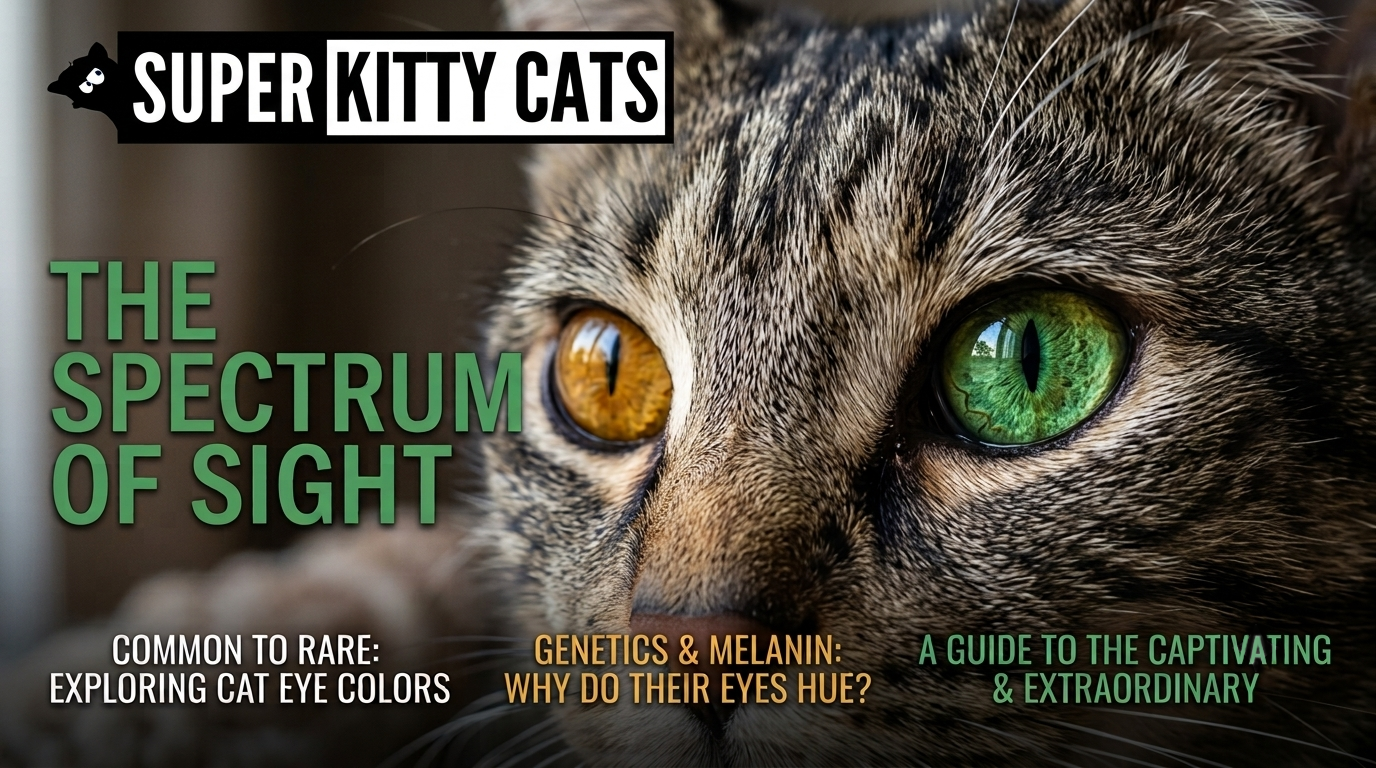
Complete heterochromia (heterochromia iridis) occurs when a genetic developmental gene prevents melanocytes from migrating to one eye. This leaves one eye permanently blue (unpigmented) while the other eye develops its natural pigmented shade.

• Expert Myth Check: Be cautious of digitally manipulated images online! Natural odd-eyed cats always exhibit distinct, biologically plausible colors without a fluorescent glow.

📸 Image 7: An all-white Turkish Angora with one sapphire-blue eye and one warm amber eye.

8. Dichroic Eyes (Sectoral Heterochromia)

RARITY SCORE 10 / 10 (Ultimate Rarity)
                         PRIMARY HUES                     Dual Colors in the SAME Iris
ASSOCIATED BREEDS Occurs randomly in domestic breeds

The absolute pinnacle of feline eye rarity. Sectoral heterochromia occurs when different sectors of a single iris contain dramatically different quantities of melanin. This results in two distinct colors within the same eye—such as a ring of gold surrounding a green center, or a distinct pie-slice section of amber.

📸 Image 8: Extreme macro shot of a single feline eye showing a clear, distinct pie-slice section of rich amber embedded in an otherwise jade-green iris.

Veterinary Insight: When Eye Color Changes Mean Danger

While genetic eye colors remain stable after a kitten reaches 3 to 4 months of age, sudden eye color changes in adult cats are a medical emergency. If you notice any of the following symptoms, consult a licensed veterinarian immediately:

  • Uveitis (Intraocular Inflammation): Causes the iris to appear muddy, reddish, or dark brownish. Often driven by systemic infection or trauma.
  • Glaucoma: Increased pressure inside the eye causing a cloudy, bluish, or hazy appearance accompanied by corneal swelling.
  • Iris Melanosis & Melanoma: Development of brown or black freckles/patches on the iris. While some freckles are benign, others can progress to malignant melanoma.
  • Cataracts: A milky white or grey film behind the pupil, obscuring vision and light refraction.

Your cat’s eyes are not only a doorway into their expressive emotions but also a remarkable testament to feline genetics. By paying close attention to their unique appearance and monitoring for unexpected changes, you can ensure your beloved companion enjoys brilliant vision and vibrant health for a lifetime.

1 Response

Jose
Jose

8月 06, 2026

I have had 10 cats, and seen many others over the years. Never before have i seen the almost brown eyes of my current cat – a darker amber. He has black and grey top coat, and a very light grey undercoat. I am very lucky he chose my gate to enter, aged 3 weeks. At that age his eyes were blue.

Leave a comment

Comments will be approved before showing up.